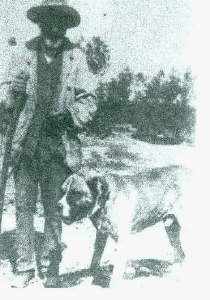
With domestication for utilitary uses, the
Cane Corso had in time gone through changes in conformation
physically and mentally. Between various typologies of dogs,
it can be confirmed that "Cane Corso" descends from the molossoid, a
dog who demonstrated a very strong and robust form who went into
acts of combat.
The use of
the breed was very diversified, primarily used for guarding property
and protecting cattle against wolves and cattle thieves. For
decades, the Cane Corso was used for hunting large game such as wild
boar, wolf and bear, an activity very popular among the
nobles. Usually, they used both Segugio (tracking dogs) and
Cane Corso together. The breed had an optimum hunting instinct
and would bring back a good meal for the shepherds. He was
also popular amongst drivers who transported goods through
Italy. The dog would run along side the horse and cart and
protect against highwaymen.
During this century, as agricultural
production modernized, the need for this breed decreased, numbers of
the population fell drastically and become more rare. From the
1950's up to the early 1980's Cane Corso was kept alive by just a
few shepherds and farmers in isolated parts of Southern Italy. The
Cane Corso was inevitably considered to have had, since remote
times, a great importance to man which led to the recontruction of
the breed. A dog which surely is the most antique domesticated
animal that, in the course of milleniums, achieved a position of
privilege in the human community that was reached by no other
animal.
Mental
Characteristics
Alert, attentive, protective and of stable
mind. The disposition of this breed makes it an attractive one. Cane
Corsos make formidable family guardians, loyal pets and highly
trainable working animals. They should be submissive to its family,
yet suspicious and threatening to strangers. They are physical, but
gentle with children and do best in situations where they can be
part of a family or used in day-to-day working situations. This
breed does not do well if it has too much idle time to spend.
Because they are an active breed, they can become destructive if
boredom sets in.
Although Corsos can run large in size, they
make great house animals. These dogs just want to be around people.
They can adapt well to most housing situations and usually stay very
close to their property, not wandering from home. Cane Corsos
require lots of exercise to stay happy and healthy. At times, they
can be highly excitable or stubborn, so early socialization, backed
up with positive reinforcement and obedience training is highly
recommended."
A farmer from S. Paola di Civitale
(Foggia) - as told by Alfonso Comer
*Mr. Michael Ertaskiran has made many, many
trips to Italy and often speaks with farmers who have had and used
Cane Corsos on the masseria (farm) for generations. Here are the
words of one farmer, Alfonso Comer, translated by Mike.
"The Cane Corso breeders of S. Paola are
or were the Cilla, the Petardi and the Caldarola. The reason that
this breed is found in S. Paola is because here until not long ago,
there were the large hog farms. We are talking of breeding in the
wild consisting of about 200 animals of a local breed, small, with a
black spot on their back, with lean meat and when fattened up they
would form a heavy layer of lard. A kind of reverse transhumance
would be practiced: in the winter the flock would be taken to the
forests to forage while from June to August they would be brought to
the fallow fields, the fields left uncultivated in preparation for
the cereals. The fallow fields are superficially worked with the
plow and harrow. This type of soil is rich in nutrients and the
hogs, besides vegetable substances, would find rodents, worms and
insect larvae.
Because of the seasonal heat the pigs
would graze at night while during the day they would seek the cool
and humid spots, under the scrubs, and they would dig holes and lie
there all day. At dusk they would start to root about. At midnight
they would head to the watering place, they would be there for about
half an hour and back away till dawn and back to their cool and
humid bedding places in the vicinity of S. Marzano, Vena,
Orticellak, S. Antonio and Tono where there was plenty of steady
water. The habit of night grazing, out of everyone's view, created
abuse problems of which each herd had a clearly marked zone
separated from the nearby one by a free corridor.
The Corso would become indispensable when,
at the moment of giving birth, the females would go to the thick
vegetation to hide. When the farmer noticed when the sow was
missing, he would get on his horse and head for the thick vegetation
areas that in his experiences would be the place the sows would seek
under these circumstances. The dog soon enough would locate the
female with the litter, but here it became difficult, because the
sow is a strong animal and would defend its offspring ferociously.
Anyway, thanks to its dexterity and strength, the Corso would
resolutely seize the animal and hold it immobilized until the farmer
had time to get the little ones in a sack. Once the man was back on
the horse he would give the release command and would start back to
the masseria. The sow would anxiously follow her offspring back to
the farm where they would be reunited.
The boars would also become very
dangerous, especially when they got past a certain age. They would
become especially untouchable at the time of the mounts, because
they were excited from the females scent and because they were
transported from one farm to another. Many farmers used one male.
Even here the intelligent, able, strong and courageous Corso was
indispensable, ready to jump the moment the boar would rebel. Many
farmers were saved from the tusks of these, thanks to the leaps of
their Corso. These nightly habits favored encounters with wild
animals that would normally sleep during the daylight
hours.
The badger spends the day sleeping in the
den underground tunnels that are practically inaccessible. But at
sundown, it exits its den, leaves the forest and heads for the
fields to eat. Badger meat is willingly eaten, noted are the
curative capacity of its fat from any form of arthritis; the skin is
sold to make brushes and horse harnesses. The hunt starts pretty
late, around 10:00 pm, in order to give the badger enough time to
distance itself from its den. Its useful if there is some light from
the moon in order to see where you are going. You would need a
couple of scent hounds to find the tracks and follow it, and
naturally a Corso to take the animal.
The farmers were not the only ones to
practice this kind of hunt but also of other passionate that would
borrow the dogs for the occasion. Upon leaving the village, we would
begin to follow a predetermined route that would basically be a
large circle and at the end of the night would bring us back to the
starting point. The direction of the course was established based on
the prevailing winds, because the badger had a great sense of smell.
On very calm nights the chances of getting anything are slim. We
would then walk the outer limits of the forest and hopefully we
would encounter the tracks that the animal used to get to the
vineyards or cornfields. The segugi run silently and ahead, often
out of view, while the Corsos remain close to the men. There is a
need to steer wide of the masseria or you would have to face the
fury of the guard dogs. Here, the Corso takes off silently toward a
point in the darkness that only he knows: he heard the whining
coming from the scent hounds, the segugi, and that to him is a clear
message. The men do nothing; they hurry to the point where they
observed the Corso disappear and by the time they get there all is
finished. The badger is a robust and combative animal and has a
strong defense but the expert Corso knows where to grab him and
dispatch him in an instant. During this night hunting we at times
harvested otters by the Fortore. Today many dogs that are "served
up" as Corsos are crossbreeds. The Corso has dry lips that should
not hang at the angle of the mouth."
*************************************************************************************
Here are a couple of links to Cane Corso
History pages (please keep in mind that the information can be
subjective):
http://www.canecorsoitaliano.net/uhist.htm
http://www.canecorsoinfo.org/history.htm
http://www.canecorso.org/history.htm



