|
CaneCorsoStandard.com
This is the standard that the AICC, ACCP (molossian
breeds) and Arcicaccia CSSA (all breeds) use, as well as the ICCF,
the largest Cane Corso registry in the U.S. (as of January 1,
2004). The largest (entrywise) annual Cane Corso show in the
world was held in Rome in the summer of 2003 and this is also the
standard they used. Most importantly, this is the standard that
reflects some important changes to the FCI Standard that we hope
will be recognized in 2006, when revisions will be
permitted.
The AICC Proposal and changes to the FCI* Standard No.
343 (the worldwide and country of origin standard are noted in red text (thanks to
Nick DiCroce for translating!)
*Note: FCI (Fédération
Cynologique Internationale)
is the world canine organization founded in 1911, which
includes 79 member countries and recognizes 331 breeds. They
are not to be confused with FIC (Federation of International
Canines), which is a very small privately owned registry in the
U.S.
************************************************************************
AICC PROPOSAL
- It seems logical to us that before undertaking any program
of zootechnical selection, it is necessary to focus on the reality
of the breed and to verify the functionality of the tools that are
at our disposal to get the preset results.
PREMISE - If it should be used as a
guide by the breeders in the selection (the breeders should be
breeding according to the standard and the judges should be judging
within its parameters), we believe it is indispensable and necessary
that the breed standard should be revisited again in those parts
that contain errors, omissions and/or incongruities, as it would be
common to all the initial drafts of any standard.
It should be
noted that today there are no political demands that would force us
to select a dog with specific characteristics only to distance it
from another dog.
The necessary
changes for its functional adjustment should not sound as disrespect
towards Dr. Morsiani, prematurely departed, but the continuation and
the development of his work, that among a lot of difficulties, has
been conclusive for the recognition of the breed. Changes have been
proposed to the standard to make it more harmonic in its various
parts, as for instance the constitutional aspect of a trotter that
introduces its incongruities with the angle of the pasterns, the
feet and the angles of the posterior.
Particularly
important are the points regarding the head, where a serious gap
exists around the nose color. The bite, for a long time the object
of discussion in the Cane Corso, finds in the proposal a greater
match to the history of the breed (as broadly documented) and
functional without twisting the type, as well as the recovery of an
important reference cinometric for the canine teeth, pointed out by
Dr. Morsiani in the first draft.
As far as the
eyes, we are proposing a clear distinction of the colors in regards
to the coat, distinction that should allow greater clarity in
judging. We also propose the cancellation of the characteristics of
the protruding eyes, because besides not being a characteristic of
the breed, it further forces us to select a morphological/functional
defect.
The neck is
one of the parts, together with the bite, that has seen the need for
diversification of the standard of the Cane Corso from that of the
Neapolitan Mastiff. It seems to us that the formulation proposed
regarding the skin of the neck is more consistent with the reality
of the breed.
The height and
weight, although object of small changes in July 1995, are still an
inaccurate indication. The proposal, besides being more adherent to
the reality of the breed, proposes the reduction of the
distance/width of a bite (as in the distance/width of an open
scissors) as it relates to the size of the subjects and it also
proposes the recovery of consistency, especially in the females
(since today's Cane Corsos are not as massive as they were in the
past) to give the breed some more homogeneous and functional image.
The weight is compared relative to the height, also specifying
tolerances.
Proposals of change in the interested areas: (see
additions to the standard below)
|
FCI STANDARD NO.
343
Medium-large sized molossoid,
unicolor, compact,with a strong skeleton, muscular and
athletic, it moves with considerable ease. Its head is
massive, with a dignified and proud expression. It has had a
selection parallel to that of the mastiff, it comes from
lighter progenitors but has maintained that original
conformation. It has always been a property watchdog and
hunter of difficult game, such as the boar. It originated in
the central-southern regions of Italy where it was used as a
cowherd for cows and swine raised in the wild. It also
defended travelers and carters from highwaymen. Its name is
the one by which it has always been known in the south, having
the same root as "corsiero" (courser), the medieval war horse;
perhaps it derives from the Latin "cohors" (courtyard,
bodyguard). Due to environmental changes, the Courser risked
extinction. A few enthusiasts initiated its recovery which
today is complete. Its modern functions are watchdog,
defending people and their belongings. An adaptable and
courageous worker, of proverbial loyalty, alert and reactive,
able to withstand difficult environmental conditions and
experiences due to its solid equilibrium. A strong build but
not without elegance. Built on a rectangle, it absolutely must
not resemble the Neapolitan Mastiff. Its skin adheres to its
body and does not form wrinkles.
BRIEF HISTORICAL SUMMARY - Its direct ancestor is the
"Canis Pugnax" (the old Roman Molossian) of which he is the
light version employed in the hunting of large wild animals
and also as an "auxiliary warrior" in battles. For years he
has been a precious companion of the Italic populations.
Employed as property, cattle and personal guard dog and used
for hunting purposes too. In the past this breed was common
all over Italy as an ample iconography and historiography
testify. In the recent past he has found a excellent
preservation area in Southern Italy, especially in Puglia,
Lucania and Sannio. His name derives from the Latin "Cohors"
which means "Guardian", "Protector".
GENERAL APPEARANCE -
Medium-big size dog, strongly built but elegant, with powerful
and long muscles, very distinguished, he expresses strength,
agility and endurance. The general conformation is that of a
mesomorphic animal whose body is longer than the height at the
withers, harmonious as regards the form and disharmonious as
regards the profile.
IMPORTANT PROPORTIONS - The length of the body is about 11% over the height
at the withers. The total length of the head reaches 36% of
the height at the withers. The length of the muzzle is equal
to 34% of the total length of the head. The height of the
thorax is 50% of the height at the withers and it is equal to
the height of the limb at the
elbows.
BEHAVIOR AND TEMPERAMENT - Intelligent, active and even-minded, he is an
unequaled watch and protection dog. Docile and affectionate
with the owner, loving with children and with the family, if
necessary he becomes a terrible and brave protector of people,
house and property. He is easily trained.
HEAD - Brachycephalic.
Its total length reaches 36% of the height at the withers. The
bizygomatic width, which is equal to the length of the skull,
is more than half the total height of the head, reaching 66%.
The upper longitudinal axes of the skull and of the muzzle are
slightly convergent. The perimeter of the head, measured at
the cheek-bones, is more than twice the total length of the
head even in the females. The head is moderately sculptured
with zygomatic arches stretched outwards. The skin is firm and
sticking to the tissues underneath, it is smooth and quite
stretched.
CRANIAL
REGION
Skull - Seen from the front
it is wide and slightly curved, seen from the side it draws
an irregular curve that, accentuated in the subregion of the
forehead, becomes flat along the external saggital crest.
Seen from the top, it looks square because of the
outstretching of the zygomatic arches and the powerful
muscles swathing it. Frontal sinuses well developed and
stretched forward, deep forehead hollow and visible median
furrow. Occipital crest not much developed. Supraorbital
fossae slightly
marked.
Stop - Very marked because
of the very developed and bulging frontal sinuses and
because of the prominent superciliary arches.
FACIAL
REGION
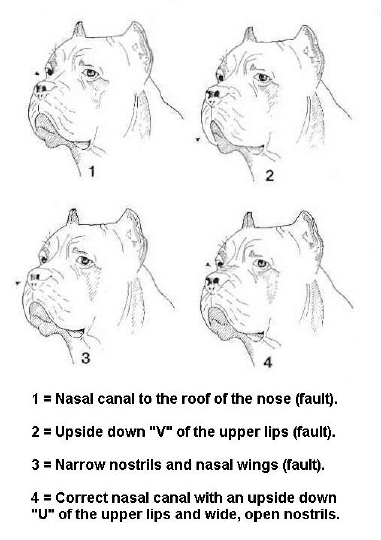
Nose - It is on the same
line as the nose pipe. Seen from the side it mustn't stick
out from the front vertical margin of the lips but be, with
its front, on the same vertical line as the front of the
muzzle. It has to be voluminous, rather flat on top, with
wide nostrils, opened and mobile, wet and cool. The
pigmentation is
black.
It should be expected to be dark grey
in color for the subjects of grey color, grey brindle and
tawny with a grey
mask.
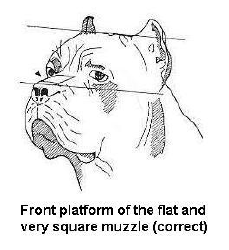
Muzzle - Very broad and
deep. The width of the muzzle must be almost equal to its
length, which reaches 34% of the total length of the head.
Its depth is more than 50% the length of the muzzle. Due to
the parallels of the muzzle sides and to the fullness and
the width of the whole jaw, the anterior face of the muzzle
is flat and square. The nasal bridge has a rectilinear
profile and it is rather flat. The lower side profile of the
muzzle is determined by the upper lips, the suborbital
region shows a very slight
chisel.
Lips - Rather firm. Seen
from the front, the upper lips form at their disjunction an
upside down "U" and, seen from the side, hang moderately.
The commisure is rightly evident and it always represents
the lowest point of the lower side profile of the muzzle.
The pigmentation is
black.
Jaws - Very wide, strong
and thick, with a very slight shortening of the upper jaw
with a subsequent light prognatism (undershot mouth). The
branches of the lower jaw are very strong and, seen from the
side, are quite curved, the body of the lower jaw, well
accentuated forward, points out well the marked chin. The
incisors are firmly placed on a straight
line.
Very wide, strong and thick. They can
have a slight shortening of the upper jaw and
consequently, a slightly undershot bite. White, big,
complete in growth and number. The canines should be
divergent and very distant among them (in the males, in
the apex of the crown, they would need to be no less than
5.5cm-5.7cm or
2.16"-2.24" apart).
Cheeks - The masseter
region is full and evident, but not
hypertrophic.
Teeth - White, big,
complete in growth and number. The lower jaw incisors pass
only slightly (about 0.5 cm or 0.19") their
correspondent ones on the upper arch, so the bite is
slightly undershot.
The bite should be slightly undershot
(maximum 0.5 cm or 0.19") or level. A scissors bite would
be tolerated only if all the other parameters (length of
the muzzle, parallel muzzle sides, the upper longitudinal
axes of the skull and of the muzzle are slightly
convergent) are
correct.
Eyes - Of medium size
compared to the size of the dog, in a sub-frontal position,
well spaced. Rima palpebrarum nearly oval, eyeballs slightly
protruding, adherent eyelids with the borders pigmented with
black, the eye mustn't let the sclera be seen. Third eyelid
strongly pigmented. Iris as dark as possible according to
the color of the coat. Look intelligent and
alert.
To delete: "slightly protruding"
(defect). Color for the subjects with a black muzzle
(black, tawny and brindle): iris as dark as possible. For
the subjects with a grey muzzle (grey, tawny and brindle):
light brown color, lighter colorations are
approved.
Ears - Of medium size in
relation to the volume of the head and to the size of the
dog; covered with short hair, of triangular shape, with
rather pointed apex and thick cartilage, in a high position,
much above the zygomatic arch, with a wide bottom, hanging,
they stick to the cheeks without coming down to the throat.
Quite outstretched and slightly protruding at the joint,
they become semi-erect when the dog is watchful. They
usually get amputated in a equilateral-triangular
shape.
NECK
Top line - Slightly
arched.
Length - 36% of the height
at the withers, that is equal to the total length of the
head.
Shape - Of oval section,
strong, very muscular, with a marked disjunction form at the
nape. The perimeter, at half length of the neck, is about
80% of the height at the withers. Harmoniously joined with
the withers, shoulder and chest, the neck has its ideal
direction at 45° from the ground and at right angle with the
shoulder.
Skin - The lower margin of
the neck is practically without
dewlap.
To delete: "...the neck is
practically without dewlap." To insert: "The inferior part
of the neck introduces more abundant but elastic
skin."
BODY - Compact, strong
and very muscular. Its length is 11% over the height at the
withers, with allowance of
±1%.
Top line - The back region
is rectilinear with a slightly lumbar
convexity.
Withers - They clearly rise
on the dorsal line and over the rump level, are high, long,
wide. They are lean and joint harmoniously to the neck and
to the back.
Back - It is wide, very
muscular as the whole upper line of the trunk, slightly
climbing from the back to the front and with a strictly
rectilinear profile. Its length is approx. 32% of the height
at the withers.
Loins - The lumbar region
has to be short, wide, well joined to the back and to the
back and to the rump, very muscular, very solid and, seen
from the side, slightly convex. Its length, slightly higher
than its width, is equal to 20% of the height at the
withers.
Croup - It is long, wide,
quite round due to the considerable growth of the muscles.
The length, measured from the ridge of the hip to the ridge
of the nates is equal to 32% of the height at the withers.
Its average width is equal to 23% of the height at the
withers, its inclination on the horizontal line, on the
basis of the ilium-ischiatic line is of 28°/30°, on the
basis of the line from the ridge of the hip to the insertion
of the tail is of 15°/16°. Therefore the rump is slightly
inclined.
Chest - Wide, well inclined
and open, with well grown muscles. Its width, in close
relation with the width of the thorax, reaches 35% of the
height to the withers, the breast-bone is at the same height
as the tip of the shoulders. Seen from the side, the chest
is outstretched forward between the fore legs and slightly
convex.
Thorax - It has to be well
grown in the three dimensions with long, oblique, wide and
well hoped ribs with wide intercostal spaces. The 4 false
ribs are long, oblique and open. The thorax reaches down at
the elbow and its height is equal to half the height at the
withers. Its width, measured at half of its height, is equal
to 35% of the height at the withers and decreases slightly
towards the sternum region without forming a carina. The
depth (saggital diameter) is equal to 55% the height at the
withers. Its perimeter is over 35% the height at the
withers.
Underline and belly - The
sternum region is lean, long, wide and seen from the side it
outlines a semicircle with a wide radius which caudally goes
up smoothly to the abdomen. The abdomen region is neither
hollowed nor relaxed and, seen from the side, rises up from
the sternum edge to the groins with a smooth curve. The
hollow on the side is not very
marked.
Tail - It is inserted quite
high on the rump line, it is thick at the root and not too
tapering at the tip, and if stretched is not too much over
the hock. When not in action is low. Otherwise is horizontal
or slightly higher than the back, it must never be bent to
form a ring or in a vertical position. It gets amputated at
the 4th vertebrae.

Body
with the more frequent defects (by the book"Il Cane Corso"
R. Carosio)
LIMBS
FOREQUARTERS - Perpendicular, seen from
the front or in profile. The height of the limbs at the elbows
is equal to 50% of the height at the withers. Well
proportioned to the size of the dog. Strong and
powerful.
Shoulder - Long, oblique, strong,
equipped with long, powerful and well divided muscles, is
adherent to the thorax but free in the movements. Its
length, from the top of the withers to the ridge of the
shoulder, is equal to 30% of the height at the withers and
its inclination on the horizontal line is between 48°/50°.
In relation to the median plane of the body the ridges of
the shoulder-blades are slightly
swerved.
Arm
- It is slightly longer than the shoulder, strong, with very
well grown bones and muscles, well joined to the trunk in
its top 2/3, measured from the ridge of the shoulder to the
tip of the elbow, it has a length equal to 31/32% of the
height at the withers and an inclination with the horizontal
line of approx 58°/60°. Its longitudinal direction is
parallel to the median plane of the body. The angle between
the shoulder-blades and the humerus is between 106° and
110°.
Elbows - The elbows, long and
protruding, adherent but not too close to the ribcage,
covered with lean skin, must be like the humeri, on a
strictly parallel plane to the sagittal plane of the trunk.
The tip of the elbow (olecranon epiphysis) is located on the
vertical line lowered from the caudal (or back) angle of the
shoulder-blade to the ground.
Forearm - It is perfectly vertical, oval
section, with several muscles, in particular in the
top-third, with a very strong and compact bone structure.
Its length, from the tip of the elbow to the one of the arm
is equal to 32/33% of the height at the withers. Its
perimeter, measured straight underneath the elbow, is equal
to 39% of the height at the withers, the carpus-cubital
groove is quite marked.
Carpal
joint - Seen from the front, it follows the straight
vertical line of the forearm; it is lean, wide, mobile,
thick. Its perimeter reaches 26% of height at the withers,
at its top margin the pisiform bone is strongly projected
backwards.
Pastern - It is quite smaller than the
forearm, is very strong, lean, elastic, slightly flexed (it
forms with the ground an angle of approx. 75°). Its length
must not be over one sixth of the height of the forelimb at
the elbow. Seen from the front, it follows the perpendicular
line of the forearm and of the carpus.
Pasterns form an
angle with the ground of 72/73°
Forefeet - They have a
round shape, with very arched and gathered toes (cat's
foot). Lean and hard soles. The nails are strong, curved and
pigmented, there is a good pigmentation also in the plantar
and digital pads.
Foot is of oval
form with very arched and gathered
toes.
HINDQUARTERS
- Perpendicular, seen from the front or in profile. Well
proportioned to the size of the dog, strong and
powerful.
Thigh - It
is long and wide, with prominent muscles, therefore the nate
ridge is well marked. Its length is over 33% of the height
at the withers and the width is never lower than 25% of such
height. The thigh-bone axis, quite oblique from the top to
the bottom and from the back to the front, has an
inclination of 70° on the horizontal line and forms with the
coxal axis an angle which is slightly more than right
(coxo-femural angle).
Second
thigh - It is long, lean, with a strong bone and muscle
structure, has a well marked muscular groove. Its length is
equal to 32% of the height at the withers and its
inclination from the top to the bottom and from the front to
the back is of approx. 50° on the horizontal
line.
Stifle -
The angle of the stifle joint, is of approx. 120°. Its
direction is parallel to the median plane of the
body.
The angle of the stifle joint is of
approximately 110°.
Hock joint
- It is wide, thick, clean, with well marked bone. The
protruding hock ridge shows clearly the continuation of the
leg groove. The distance from the ridge of the hock to the
sole of the foot (to the ground) shouldn't be over 26% of
the height at the withers. Its direction, in relation to the
median plane of the body is parallel. The tibio-metatarsal
angle is of approximately 140°.
The tibio-metatarsal angle is of
approximately 130°.
Hock
(Metatarsus) - It is very thick, lean, rather short,
cylindrical, and is always perpendicular to the ground, seen
from the side and from the back, its length is equal to
approx 15% of the height at the withers (tarsus and foot
excluded). Its internal side has to present itself without
spur.
Hindfeet - They have a slightly more
oval shape than the fore ones and a less arched toes.
GAIT/MOVEMENT - Long steps, stretched
trot, some steps of gallop, but with inclination to stretched
trot.
SKIN - It is rather thick, has limited subcutaneous
connective tissue and therefore is adherent everywhere to the
layers underneath. The neck is practically without dewlap. The
head mustn't have wrinkles. The pigment of the mucous
membranes is black. The pigment of the soles and the nails
must be dark.
COAT
Hair - Short hair but not smooth, with
vitreous texture, shiny, adherent, stiff, very dense, with a
light layer that becomes thicker in winter (but never crops
up on the covering hair). Its average length is approx.
2-2.5 cm (0.78"-0.98"). On the withers, the rump, the back
margin of the thighs and on the tail it reaches approx. 3 cm
without creating fringes. On the muzzle the hair is very
short, smooth, adherent and is not more than 1-1.5 cm
(0.39"-0.59").
Color - Black, plumb-grey,
slate, light grey, light fawn, deer fawn, dark fawn and
tubby (very well marked stripes on different shades of fawn
and grey). In the fawn and tubby subjects there is a black
or grey mask only on the muzzle and shouldn't go beyond the
eye line. A small white patch on the chest, on the feet tips
and on the nose bridge is accepted.
HEIGHT AND
WEIGHT
Height
at the withers
Males: 64-68 cm (25.19"-26.77").
Allowance: 62-70cm
(24.41"-27.56")
Females: 60-64 cm (23.62"-25.19").
Allowance: 58-66
cm (22.83"-25.98")
Males: 65-68 cm
(25.59"-26.77"). Allowance:
63-70 cm
(24.80"-27.56")
Females: 62-65 cm (24.41"-25.59").
Allowance:
61-66 cm
(24.02"-25.98")
Weight
Males:
45-50 kg (99.2-110.2 lbs.) Ratio weight/size 0.71
(kg/cm).
Females:
40-45 kg (88.2-99.2 lbs.) Ratio weight/size 0.68
(kg/cm).
Males: 47-53 kg (103.6-116.8
lbs.) Allowance: 44-56 kg
(97.0-123.5
lbs.)
Females: 40-46 kg (88.2-101.4
lbs.) Allowance: 38-48 kg (83.8-105.8
lbs.)
To delete: the index ratio weight/size,
since it is not
meaningful.
FAULTS - Any departure from the foregoing points should be
considered a fault and the seriousness with which the fault
should be regarded should be in exact proportion to its degree
and diffusion.
ELIMINATING
FAULTS
- Head -
Accentuated parallelism of the axes of the skull and the
muzzle very marked converging axes of the skull and the
muzzle, converging side lines of the muzzle, scissors bite,
pronounced and disturbing undershot mouth.
- Nose - Partial
depigmentation.
- Tail -
Forming a ring or in a vertical position.
- Size -
Oversize or undersize.
- Gait/movement - Continued amble.
DISQUALIFYING
FAULTS
- Head -
Diverging axes of the skull and the muzzle, overshot mouth
nosebridge resolutely hollow or ram-like.
- Nose -
Total depigmentation.
- Eyes -
Partial and bilateral palpebral depigmentation, wall-eye,
bilateral strabismus.
- Sexual
organs - Monorchidism, cryptorchidism, obvious
incomplete growth of one or both testicles.
- Tail -
Tailless, short-tail, artificial or
congenital.
- Hair -
Semi-long, smooth, fringed.
- Colors -
All colors not prescribed, white patches too wide.
Note - Males
should have two apparently normal testicles fully descended
into the
scrotum. |
******************************************************************
SOURCES:
- Standard: AICC
website, http://www.canecorsoitaliano.com
- Diagrams:
"IL CANE CORSO: Origini e prospettive del molosso
italico" by Fernando Casolino and Stefano Gandolfi, published
by MURSIA (scanned and translated by Leilani
Souza).
|


